As consumers become increasingly aware of the microplastic pollution problem, many are asking a critical question: does the pitcher filter on their kitchen counter actually protect them? Microplastic filtration — the process of physically removing microscopic plastic particles from water — has become a key consideration for health-conscious households. Yet until now, there has been little independent data comparing how well common pitcher filters actually perform this task.
This study evaluates the microplastic filtration effectiveness of 5 commonly used pitcher filter types, measuring their ability to remove microplastic beads from drinking water. SiMPore and Parverio partnered to utilize SiMPore’s silicon nitride filters for microplastic particle capture and Parverio’s proprietary image analysis methods — establishing a rigorous benchmark for microplastic filtration testing.
RESULTS
Pitchers ranked by microplastic filtration efficiency (highest to lowest % removal of microplastic beads):
- Pitcher 5 — 99.98%
- Pitcher 4 — 99.7%
- Pitcher 3 — 99.1%
- Pitcher 1 — 98.4%
- Pitcher 2 — 97.6%
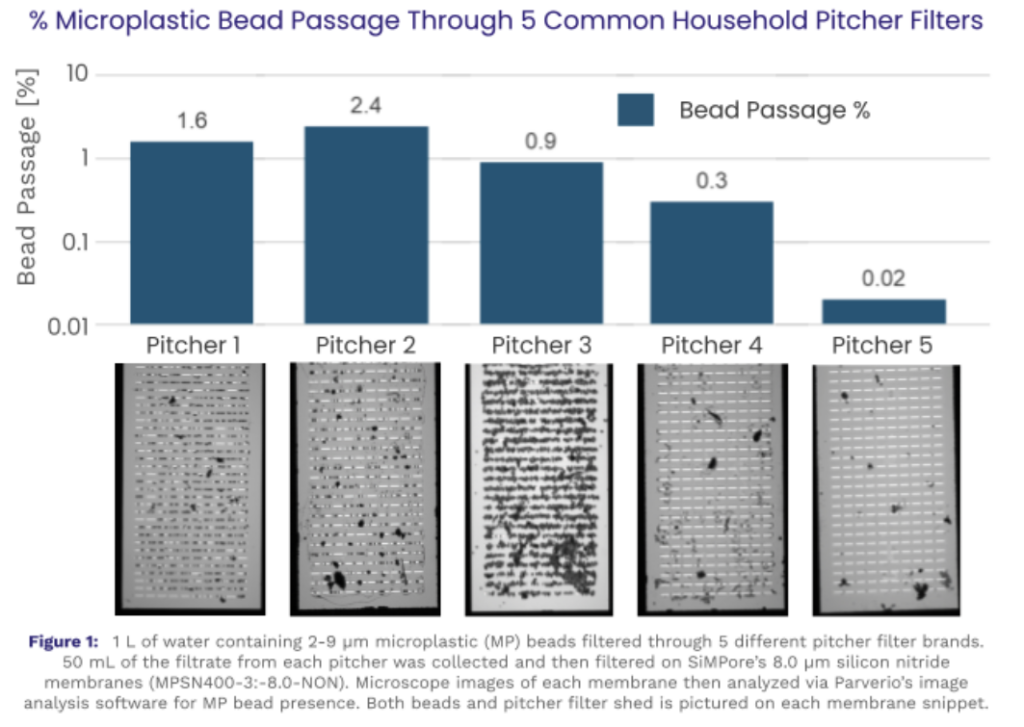
During testing, some pitcher filters also shed particles from the filter itself, as indicated by the morphology of captured particles. These non-bead particles were not counted in the filtration efficiency calculations.
Some of these non-bead particles may also be plastic in origin, as certain filter types are manufactured in part with plastic components. Other particle types released by the filters may include charcoal, resin, or other filtration media, depending on the composition of the filter in question.
CONCLUSIONS
Commonly available pitcher filters show a meaningful degree of variability in their microplastic filtration performance. Pitcher 5 removed over 120x more microplastic beads than Pitcher 2 — a striking difference for products sitting side by side on store shelves. However, the encouraging takeaway is that all five pitchers in this study removed over 97% of microplastic beads from water samples, suggesting that household pitcher filters are a viable first line of defense for microplastic filtration at home.
As microplastic contamination in drinking water continues to draw public and scientific attention, studies like this one provide consumers with the data they need to make informed choices — and highlight the importance of standardized microplastic filtration testing methods going forward.
MICROPLASTIC FILTRATION TESTING PROTOCOL
- Conditioned Pitchers according to manufacturer’s instructions with tap water.
- 1.3×10 6 beads suspended (2-9 µm in diameter) in particle-free water.
- Filtered 1 L of the above solution through each pitcher filter.
- 50 mL subfraction of filtrate collected, then filtered using SiMPore MSSN400-3L-8.0-NC membranes.
- Nile Red stain applied (0.1 ug/mL), washed 3x with microplastic-free water.
- Imaged using Brightfield/Fluorescence TRITC filter on Olympus microscope.
- Analyzed images using fluorescence threshold and ML-based pixel classification (Fiji, ImageJ)
- Denoising, Despeckling, Background Correction, Erosion, Dilation operations applied
- Pixel classifier trained on 4 and 8 pixel structures.
- Min/Max/Mean/Difference of Gaussians/Gaussian Blur/Laplacian/Hessian.
- Manual training to focus on bead structures, not other debris/slots.
- Same classifier applied to each set of images to increase specificity.
- Thresholded Grayscale Image Processed, size selected for 8 µm beads, circularity, and diameter.
- Watershedding, despeckling, binary erosion dilation