
Choosing the right TEM window grid is an important step in achieving reliable, high-quality imaging. Researchers must often balance resolution, mechanical durability, and compatibility with existing instrumentation when making a selection.
In this post, we outline the key factors to consider when selecting a TEM window grid and explain how each decision can impact performance in practical research applications.

Slot or Square Windows: What’s the Difference?
TEM window grids are typically available in either two-slot or nine-square configurations, and the geometry matters more than you might expect.
Square windows are inherently more robust, making them a solid choice for workflows that involve demanding or repetitive sample preparation. Slot windows, on the other hand, offer a larger uninterrupted viewing area, which can be especially useful when imaging extended samples or features that benefit from a wider field of view.
The right option depends on whether mechanical durability or maximum viewing area is the higher priority for your application.

Frame Thickness: 100 µm vs. 200 µm
All TEM window grids are designed to fit standard 3 mm TEM sample holders, but frame thickness plays a role in both compatibility and flexibility.
A 200 µm thick frame will fit most standard holders and is ideal for general TEM use. For specialized setups—such as high-tilt holders or applications traditionally using thin carbon grids—a 100 µm thick frame may be the better choice.
If your work involves advanced tilting or space-constrained holders, frame thickness is worth careful consideration.

Membrane Thickness: Balancing Resolution and Strength
Membrane thickness directly affects image quality and how well the grid holds up during sample preparation.
Thinner membranes (around 5–10 nm) are well suited for high-resolution imaging, where minimizing background signal is critical. Thicker membranes (15–50 nm) offer greater durability and can better withstand aggressive or experimental preparation methods.
Many researchers start with thicker membranes during method development, then transition to thinner membranes once protocols are finalized.

Membrane Material: Matching the Grid to the Application
Beyond thickness, membrane material plays a major role in performance. Factors such as thermal stability, chemical resistance, plasma cleanability, beam tolerance, and background signal all vary by material.
Options like amorphous silicon, silicon nitride, silicon dioxide, and carbon-based membranes each bring different strengths to the table. The best choice depends on your imaging conditions, preparation chemistry, and analytical requirements.
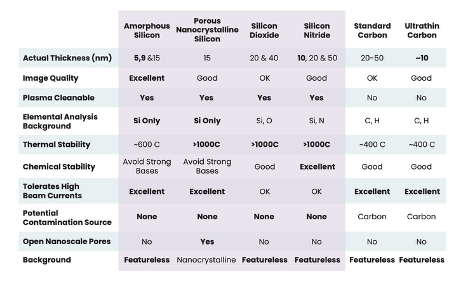
A side-by-side comparison—like the one shown in the graphic above—can make it easier to align material properties with your specific use case.

Choosing the Right Membrane Material
Different membrane materials offer varying performance depending on imaging conditions, chemical exposure, and beam intensity. Key considerations include:
● Image quality and background signal
● Plasma cleanability
● Elemental analysis background
● Thermal and chemical stability
● Tolerance to high beam currents
● Risk of contamination
Materials such as amorphous silicon, silicon nitride, silicon dioxide, and carbon-based membranes each have tradeoffs that should be matched to the experimental workflow. The graphic provides a side-by-side comparison to simplify this decision process.


Final Considerations
No single TEM window grid is ideal for every application. The best choice depends on how the grid will be used, how aggressive the sample preparation is, and the level of resolution required.
By considering geometry, frame thickness, membrane thickness, and material properties together, researchers can select a grid that delivers consistent performance while minimizing sample loss and preparation challenges.
