At SiMPore, we provide the analytical tools for the consumer beverage industry to uncover answers and validate solutions when tackling the microplastics challenge in beverage products. SiMPore Filter Disks, comprising silicon nanomembrane technology feature precision-patterned, consistent pore geometry, enabling improved particle capture and analysis methodologies over other available filter options on the market.
For this study, we analyzed seven top-producing bottled water brands with 8 µm and 3 µm cut-off SiMPore Filter Disks, reporting the total particle counts from one-liter water bottles, as well as plastic species identification via Raman spectroscopy.
RESULTS – 8 µm Cut-off Analysis
Three one-liter bottles for each brand were analyzed. Triplicate filtrations were performed, along with a control of lab-generated ultrapure water. Particles were counted, and the results revealed clear distinctions between brands with respect to particle number and particle morphology. Brands 1 and 3 contained an average of less than 30 total 8 µm+ particles, and Brand 4 had an average of almost 500 particles. Brands 4, 5, and 6 all contained particles that were larger on average, and Brands 1, 3, and 7 had the most consistent particle counts between trials.
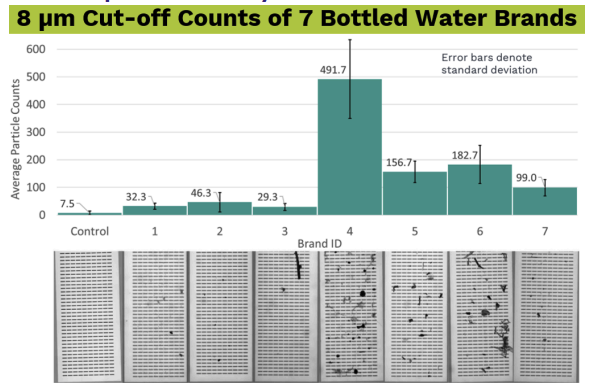
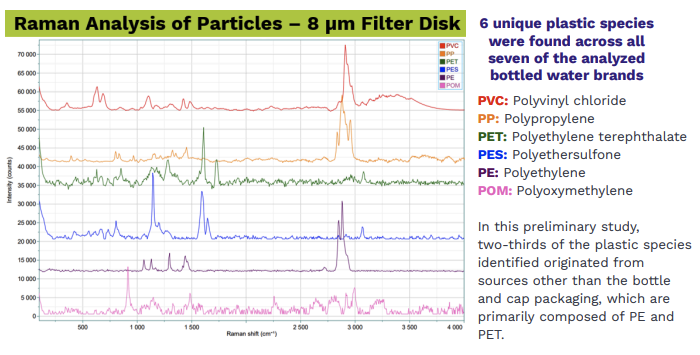
One Filter Disk was selected from each brand’s trials and a small portion of captured particles were analyzed via Raman spectroscopy using a Horiba XploRA plus instrument.
RESULTS –3 µm Cut-off Analysis
Since smaller microplastics are suspected to be more biologically harmful, we repeated the triplicate analysis of all seven brands with 3 µm cut-off Filter Disks.
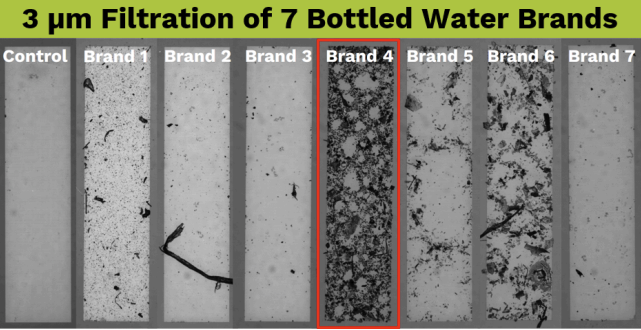
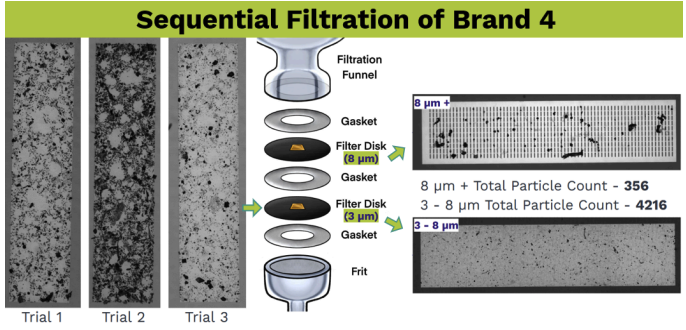
Brand 4 was found to have the highest degree of variability in its trial runs, so it was selected for further analysis. A single trial sequential filtration of Brand 4 was conducted using both 8 µm and 3 µm cut-off Filter Disk.
There were over an order of magnitude more particles on the 3 µm cut-off Filter Disk (4216ct) than on the 8 µm cut-off Filter Disk (356ct), with visibly apparent differences in particle dispersion between that of Trial 1 and Trial 3.
CONCLUSIONS
Not all plastic-packaged bottled water brands are the same – some brands can contain over an order of magnitude more 8 µm+ particles than some of their competitors. However, low particle incidence doesn’t guarantee that a given product or sample is free from microplastic contamination. In bottled water, such microplastic contamination can originate from a plastic bottle housing itself, or even from upstream processes in the production plant that are not sufficiently removed.
As particle size decreases into the realm of bioavailability (sub-8 µm), their incidence grows dramatically, suggesting a heightened need for increased analytical stringency. By utilizing SiMPore membranes, one can capture, count, and chemically identify captured particles within a wide selection of size ranges most relevant to a user’s given interest.
Additionally, the consistency of SiMPore membranes allows them to be utilized as a trustworthy QA/QC tool to ensure ongoing processes are working as intended. With a regular pore array, surface planarity, and consistency from membrane to membrane, data on analytes of interest can be collected from multiple instruments. The compatibility of SiMPore membranes with multimodal analysis streams increases the total data output potential of a single filtration run.
By adding in process control checks for microplastics at multiple stages of production, filtration, and contamination control, SiMPore Filter Disk users can implement effective solutions that can increase and continually ensure health, safety, consumer wellness, and experimental rigor, all in one fell swoop.
METHODS
- 1L bottles of water from each brand were analyzed in triplicate for both the 8 µm and 3 µm conditions.
- Each brand was analyzed by opening/closing the cap 30 times, then shaken 30 times, divided into 3 instances in which 1/3rd of the bottle volume was poured to filter. This was conducted to simulate a user’s drinking experience for each bottle.
- Membranes were imaged via reflectance mode in 4x microscopy, and particles counted via Horiba’s LabSpec6 Particlefinder software. The same settings were utilized for all membranes.
- 8 µm membranes were analyzed with Raman utilizing a Horiba XploRA plus system. 50x mag, 532 nm and 785 nm lasers, 600mm grating.
- All labware and gaskets were cleaned in triplicate with 0.22 µm filtered 99% isopropyl alcohol, and 0.22 µm filtered MilliQ water (18.2 MΩ-cm).
- Lab bench surfaces were cleaned in triplicate with 70% isopropyl alcohol and natural fiber wipes, followed by a silicone roller mat pass-over.
- Spectral matches made utilizing OpenSpecy – https://www.openanalysis.org/openspecy/
ACKNOWLEDGEMENTS
This study was funded in part with support from the National Institute Of Environmental Health Sciences of the National Institutes of Health under Award Number R44ES031036. The content is solely the responsibility of SiMPore Inc. and does not necessarily represent the official views of the National Institutes of Health. Raman data on plastic speciation collected thanks to Horiba for their gracious support by lending time on their on-site XploRA plus raman instruments.