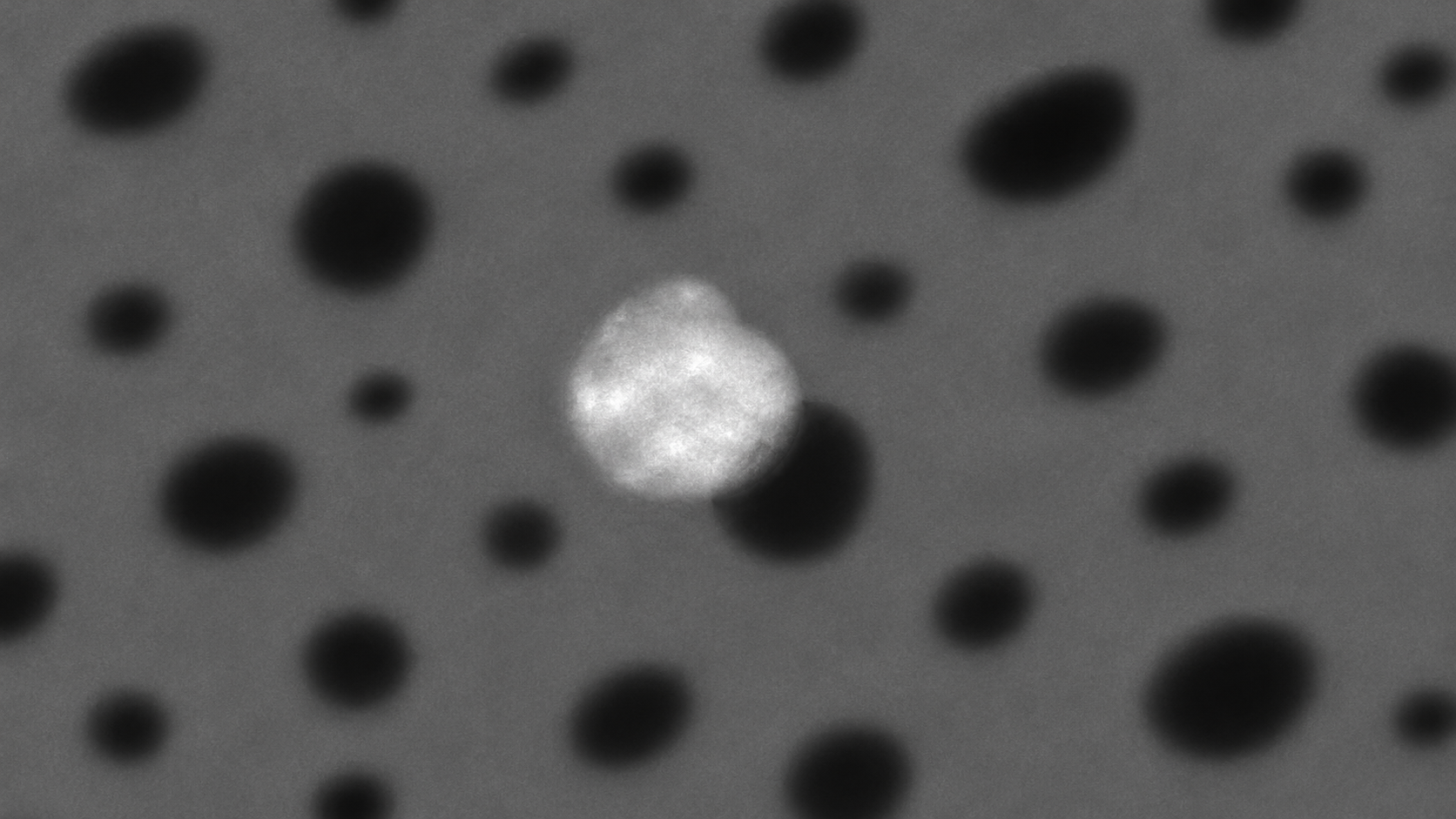
Hydrogen and ammonia contain no carbon, yet engines running on these fuels can still emit carbon-containing particles. That raises a question for emissions researchers: where do those particles come from?
A three-paper series from University of Nottingham researchers and their industry collaborators provides some answers to this question. In each study, the team captured exhaust particles on SiMPore’s nanoporous silicon nitride (SiN) TEM windows. They then analyzed the particles’ size, shape and chemistry with transmission electron microscopy (TEM) and energy-dispersive X-ray spectroscopy (EDX).
From Counting Particles to Identifying Their Sources
In the first study, Salvatore Lagana and colleagues sampled exhaust from a heavy-duty hydrogen engine during steady-state and transient operation. The researchers used TEM to examine particle size and shape, and EDX to determine which elements were present. They linked some of those elements to lubricant oil and others to sources such as coolant and engine wear. Examining the particles themselves gave the team clues about their origins that particle counts alone could not provide.
→ Read the hydrogen exhaust particle characterization study.
The second hydrogen study focused on the lubricant. Lagana and colleagues compared different oil formulations and operating conditions to investigate how they influence particulate emissions. Where the first study asked what the engine was emitting, the follow-up asked how those emissions changed when the researchers varied the oil and the way the engine was run.
→ Read the study on lubricant effects in hydrogen engines.
Philip Walters and colleagues then adapted the sampling approach for an ammonia-fueled engine. Particle concentrations were close to the detection limit of the instrument used to measure them, yet the TEM grids collected enough material for the researchers to examine individual particles. The team identified carbon-containing particles linked to lubricant oil, extending a finding from the hydrogen studies to a different fuel. The authors acknowledged SiMPore for discussions about the SiN TEM grids.
→ Read the ammonia-engine particulate emissions study.
Why the TEM window matters
In this series of papers, the carbon-free silicon nitride support helped researchers interpret carbon signals from collected particles without a carbon contribution from the support film. The open pores also let researchers image particles suspended across them with less background from the membrane. The suspended particles also enabled the researchers to analyze more definitively the particles’ elemental composition.
The ammonia study also illustrates how the choice of window depends on what researchers want to detect. Silicon nitride contributes a nitrogen signal during EDX analysis, which can make nitrogen-containing deposits harder to identify. Despite this background signal, SiN was well suited to the team’s goal of examining carbon-containing particles from lubricant oil.
Across all three studies, the same principle held: particle counts show how much is present, while microscopy and elemental analysis help explain what the particles are and where they may have come from. Explore SiMPore’s nanoporous silicon nitride TEM windows.