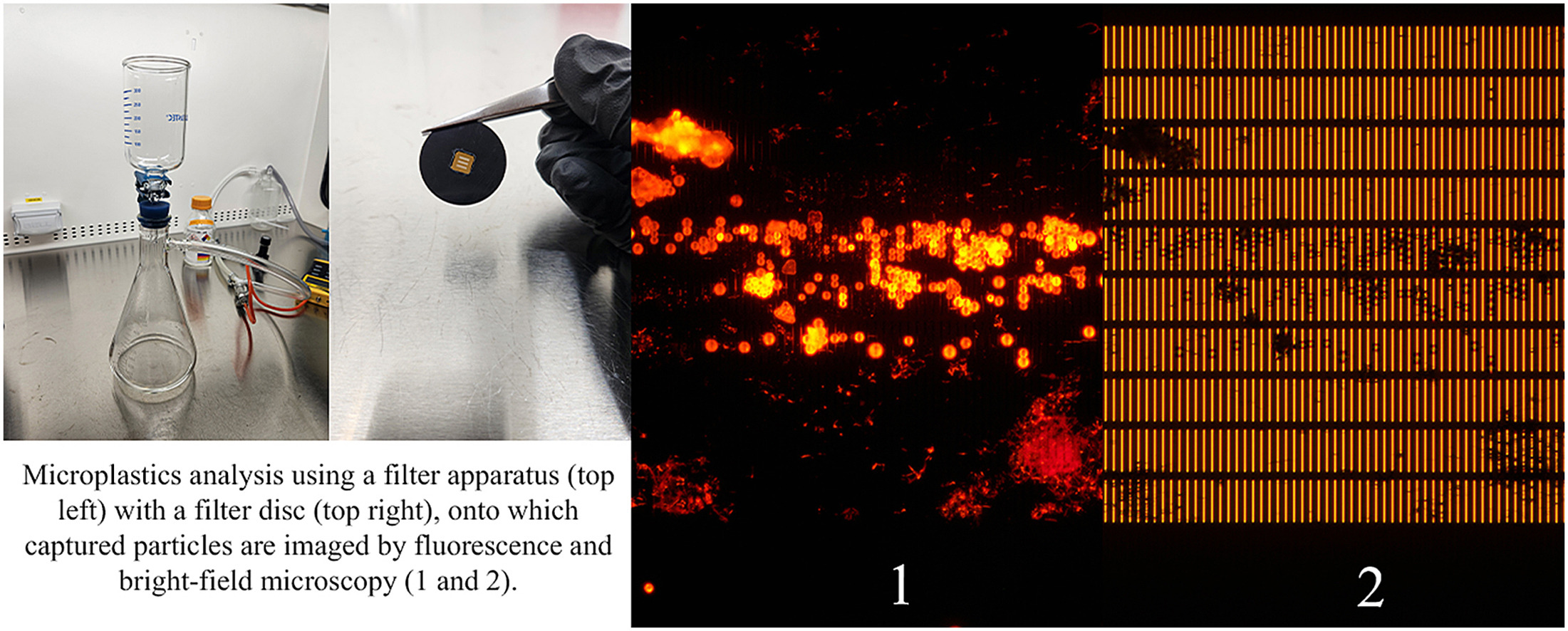
Abstract Overview
Track-etched polycarbonate (PCTE) membranes have been used as a filtration standard for microplastic (MP) capture and analysis across a variety of studies.
However, the track-etch method creates pores of varying angles that complicate onmembrane particle analysis and sometimes create merged multi-pores that allow passage of MPs > 20 µm. Additionally, the membrane’s overall ~3 µm thickness makes it prone to
folding and wrinkling, which may complicate microscopy analysis.To address these issues, a novel 20 µm gold-coated microporous silicon nitride (MPSN-Au) membrane was developed and compared directly against gold-coated PCTE (PCTE-Au) membranes via manual manipulation and processing time, pore characteristics, light microscopy particle analysis, and Raman/FTIR analysis.
We found that on an area-normalized basis, MPSN-Au membranes offered greater gas and water flux over PCTE-Au. The regular pore geometry of MPSN-Au membranes made particle imaging and spectral analysis more consistent and easier to discriminate between captured PS particles, when compared to PCTE-Au membranes. Total handling and processing time for each membrane was compared, which determined that the total processing time (including filtration, automated image acquisition, and particle counting) was 161.56% faster on average for MPSN-Au than PCTE-Au membranes.
In an 8-hour workday, 85.13% more MPSN-Au membranes can be handled, processed, and imaged than PCTE-Au, which equates to 66 vs 26 total samples, respectively. Overall, these data demonstrate the utility of MPSN-Au membranes and suggest they can significantly improve testing time-related efficiency in all aspects of normal use-case situations as compared to PCTE-Au membranes.